
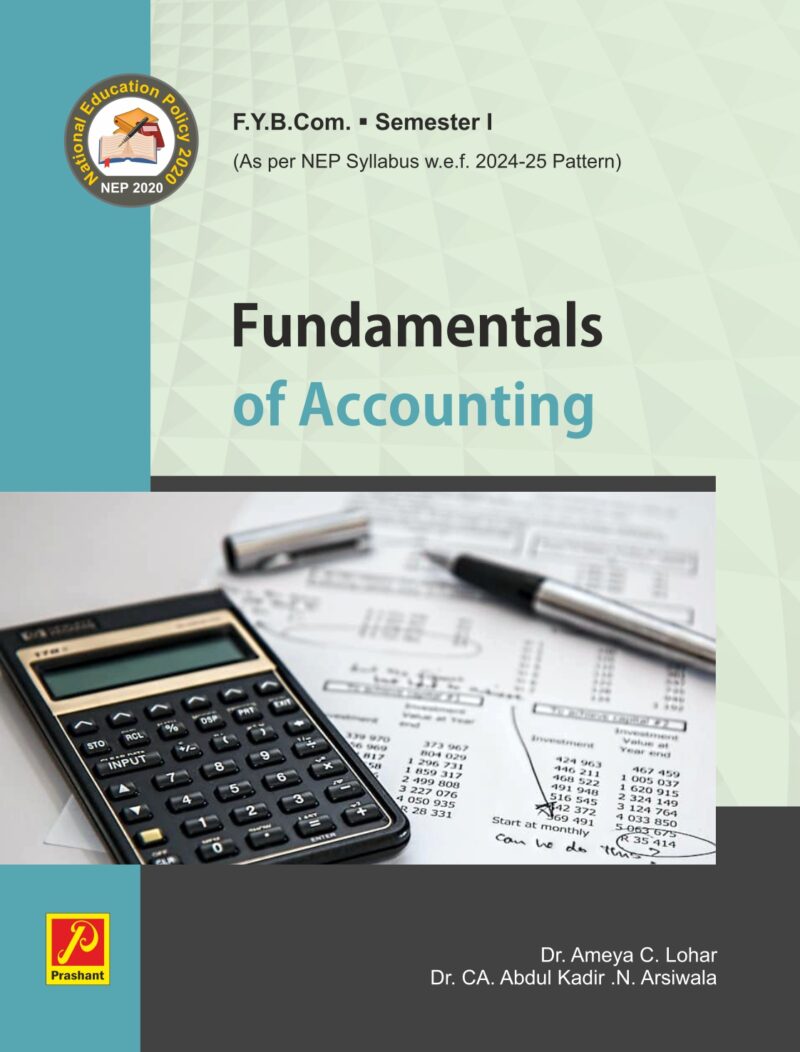
Fundamentals of Accounting
PublicationsF.Y.B.COM. SEM - I PAPER 114 (A)
Authors:
ISBN:
Rs.95.00
- DESCRIPTION
- INDEX
It is well said that ‘change is the only permanent thing in this world’.
Therefore, any change in the curriculum of a subject is part of the natural process
of development. Advancement in knowledge is possible only if a subject is
taught and learned differently at different times. Since KBC North Maharashtra
University is adopting a New Education Policy for First Year Students of
Bachelor of Commerce, it is our duty to present the necessary learning material
to them.
We are pleased to present the textbook on ‘Fundamentals of Accounting’
for F.Y.B.Com. students. It has been written in a teach-yourself style, following
a student-friendly approach. This syllabus offers a comprehensive introduction
to the field of financial accounting, exploring its meaning, definitions, functions,
objectives, advantages, and limitations. It differentiates between bookkeeping,
accounting, and accountancy while highlighting the users of accounting
information, key accounting terminology, and fundamental accounting
principles including concepts and conventions. Additionally, it delves into the
preparation and presentation of vouchers. The curriculum further examines
various branches of accounting, the accounting cycle, systems, and approaches
to accounting, types of accounts, and the rules of debit and credit. Finally, it
provides insights into the accounting equation, journal, ledger, trial balance,
and the role and types of subsidiary books essential for maintaining accurate
financial records.
We are pleased to mention that this book would never have been written
without the support and encouragement of our family members. Many thanks
to them. We are grateful to Hon’ble Vice Chancellor Prof. V. L. Maheshwari
and Pro Vice Chancellor Prof. S. T. Ingle. Special thanks are also due to
our colleagues at KBC NMU who provided inclusive comments and useful
feedback.
We are thankful to Prashant Publications, Shri Rangrao Patil, and his entire
staff. Valuable suggestions and constructive feedback from users will be highly
appreciated.
With best wishes.
1) Introduction to Financial Accounting………………………………………………………..7
1.1 Meaning, definition, functions, objectives, advantages, limitations.
1.2 Book-keeping v/s accounting v/s accountancy.
1.3 Users of accounting information, important accounting terminology, principles
of accounting – concepts and conventions.
1.4 Voucher – meaning, preparation and presentation.
2) Accounting Process…………………………………………………………………………………30
2.1 Branches of accounting, accounting cycle.
2.2 Systems of accounting, approaches to accounting.
2.3 Types of accounts – Rules of debit and credit.
2.5 Accounting equation, journal, ledger and trial balance.
3) Subsidiary Journal Books……………………………………………………………………….51
3.1 Meaning, Need of Subsidiary Books
3.2 Types of Subsidiary books – purchases book, purchases return book, sales books, sales
return book, bills receivable book, bills payable book, cash book including petty cash
book and journal proper.
Glossary……………………………………………………………………………………………………….70
Author
Related products
-
Advanced Accounting-IV
Rs.295.00 -
अन्न तंत्रज्ञान
Rs.95.00 -
Advanced Accountancy – IV
Rs.165.00