

- DESCRIPTION
- INDEX
Unit 1………………………………………………………………………………………… 7
Matter Waves
1.1 Quantum Theory of Light
1.2 de Broglie Waves
1.3 Wave Function
1.4 De Broglie Wave velocity
1.5 Wave Group (wave packet)
1.6 Relation between Wave and Group Velocities
1.7 The Diffraction of Particle (Davisson and Germer Experiment)
1.8 The Uncertainty principle
1.9 Applications of the Uncertainty Principle
1.10 Heisenberg’s gamma ray microscope: A Thought Experiment
1.11 Different forms of Uncertainty Principle
1.12 The wave particle duality
Unit 2………………………………………………………………………………………. 32
Modern Theories of H-atom
2.1 Introduction
2.2 The Nuclear Atom
2.3 J. J. Thomson’s atom model (Plum-pudding atom model)
2.4 Rutherford’s atom model (Classical planetary atom model)
2.5 Bohr’s theory of hydrogen atom
2.6 Introduction to atomic spectra
2.7 Theory of atomic spectrum of Hydrogen atom
2.8 Energy level diagram for hydrogen atom
2.9 Atomic Excitation
2.10 Experimental verification of discrete atomic levels
2.11 Correspondence Principle
2.12 Nuclear Motion and Reduced Mass
2.13 Hydrogenic Atoms 2.14 Bohr-Sommerfield model
2.15 Bohr–Sommerfeld Model and relativistic Effects
2.16 Limitations of quantum mechanical model
Unit 3………………………………………………………………………………………. 75
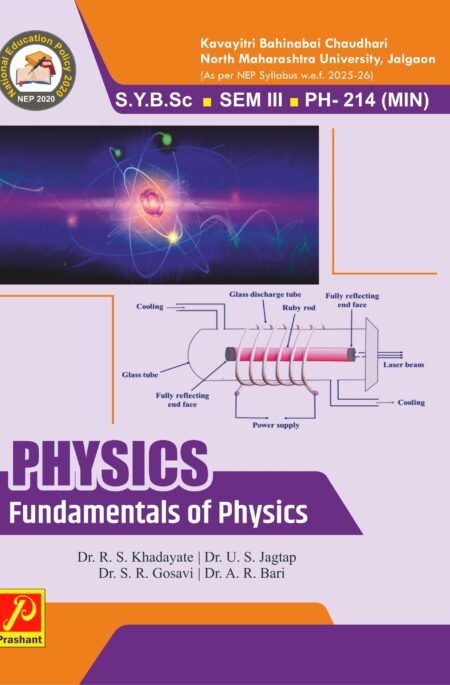
Lasers
3.1 Introduction
3.2 Basic elements and complete Laser System
3.3 Lasers and Laser Light properties
3.4 Light Emission and Absorption in Quantum Theory
3.5 Einstein Theory of Light–Matter Interactions
3.6 Types of LASER
3.7 Applications of LASER
Author

Related products
University Physics for Undergraduates
Rs.850.00PHY-103-203 | Practical Physics
Rs.130.00