
- DESCRIPTION
- INDEX
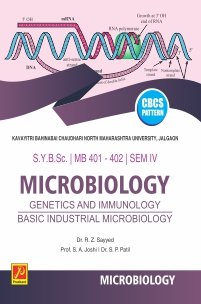
MB – 401 : Genetics and Immunology
Unit 1 : Genes and chromosomes
• Concept of gene, genome, allele, genotype, phenotype, recon, muton, cistron, intron, exon, haploid, diploid, lethal gene, partially diploid, omologous, heterologous etc.
• Typical structure of prokaryotic and eukaryotic chromosome
• Structural organization of prokaryotic and eukaryotic chromosome
• Concept of Chromosome variation (Euploidy, Aneuploidy and Polyploidy and Mitotic Non-disjunction), giant chromosome.
• Plasmid: Concept, types, structure and properties, incompatibility
• Genetic code and its properties
Unit 2 : Mutations
• Concept and significance of mutations
• Types of mutation: Base pair substitutions, frame shift, deletion, inversion, insertions, Tandem duplications, missense, nonsense, neutral, silent, pleiotropic and suppressor mutations Useful phenotypes: Auxotrophic, Conditional, Lethal, Resistant
• Spontaneous and induced types of mutation
• Mechanism of Spontaneous mutations
• Mechanism of induced mutations: Physical (UV, Gamma, and Xrays), Chemical (Base analogues, deaminating agents, alkylating agent, intercalating agent)
• Methods to study mutations: Fluctuation test, Replica plate technique, Ame’s test
• DNA repair and types of repair systems
Unit 3 : Infection and Immunity
• Immunity: concept, types (Innate, Acquired) and components of immune system and properties of immune system
• Immune Cells (stem cell, T cell, B cell, NK cell, Macrophages, Dendric cell) and organs (Bone marrow, thymus, lymph node, spleen, GALT, CALT) involved in immune response
• Non-specific immune response
• Specific immune response: Primary and secondary
• Type of immune response: Humoral and cell mediated, T and B cells characteristics
• Antigen: Concept of hapten, adjuvants, immunogen, epitope and paratope, T- dependent and T-independent antigens
• Types and properties of antigen
• Blood group: ABO antigen, Bombay blood group antigen, Dantigen and its variants, blood transfusion and rh incompatibilities
• Antibody: Types, structure and properties of each antibody, antigenic determinants on antibodies (isotypic, allotypic, ideotypic)
• Concept of Antibody diversity
• Vaccine, immune sera and toxoid
MB – 402: Basic Industrial Microbiology
Unit 1 : Basics of fermentation technology
• Characteristics of industrial strains
» Screening of industrially important microorganisms
» Primary and Secondary Screening with examples
» Screening for Amino acid / vitamin producers
» Screening for Antibiotic Producers
» Strain improvements
» Culture collection centers: National (NCIM, MCC) International (ATCC) and their role
» Preservation of microbial culture: Soil culture, Oil overlay, Liquid nitrogen Freezing, drying, Lyophilization
» Working and stock culture
• Inoculum
» Inoculum source and Characteristics
» Acclimatization
» Inoculum development and Characteristics features
• Fermentation media
» Raw materials used in media production, Screening and Selection of raw materials, typical composition and criteria for selection
» Synthetic media, Complex media and Natural media
» Sterilization: Batch Sterilization, Continuous Sterilization
Unit 2 : Fermentation
• Criteria for fermenter design and construction
• Fermenter types and parts (Impeller, baffles, sparger, stuffing box)
• Measurement and control of fermentation parameters: pH, temperature, dissolved oxygen, foaming and aeration
• Fermentation process:Submerged (Batch, Fed batch, Dual/ Multiple) Solid state fermentation, concept, characteristics and applications
• Continuous Cell growth: Chemostat and Turbidostatic
• Synchronous cell growth: Physical and Chemical methods
» Applications of synchronous culture
Unit 3 : Downstream processing
• Product isolation methods
» Cell removal
» Cell disruption: Chemical methods, Ultra sonication and Enzymatic methods
• Recovery of fermentation products
• Filtration: Theory, Filter bids,
(Examples: Pressure leaf filters, Rotatory vacuum filters)
• Centrifugation: Theory, Types: Basket centrifuge, Tubular bowl, Multi-chamber centrifuge
• Solvent recovery: Two phase aqueous extraction, superficial fluid extraction, countercurrent extraction
• Chromatography: Ion exchange, Adsorption, Affinity chromatography, GC and HPLC
• Membrane process: Ultrafiltration, Reverse Osmosis, Drying, Crystallography
Author

Related products
-
BOT-404 | Nursery and Gardening
Rs.40.00 -
Biotechnology For Degree Student
Rs.695.00