

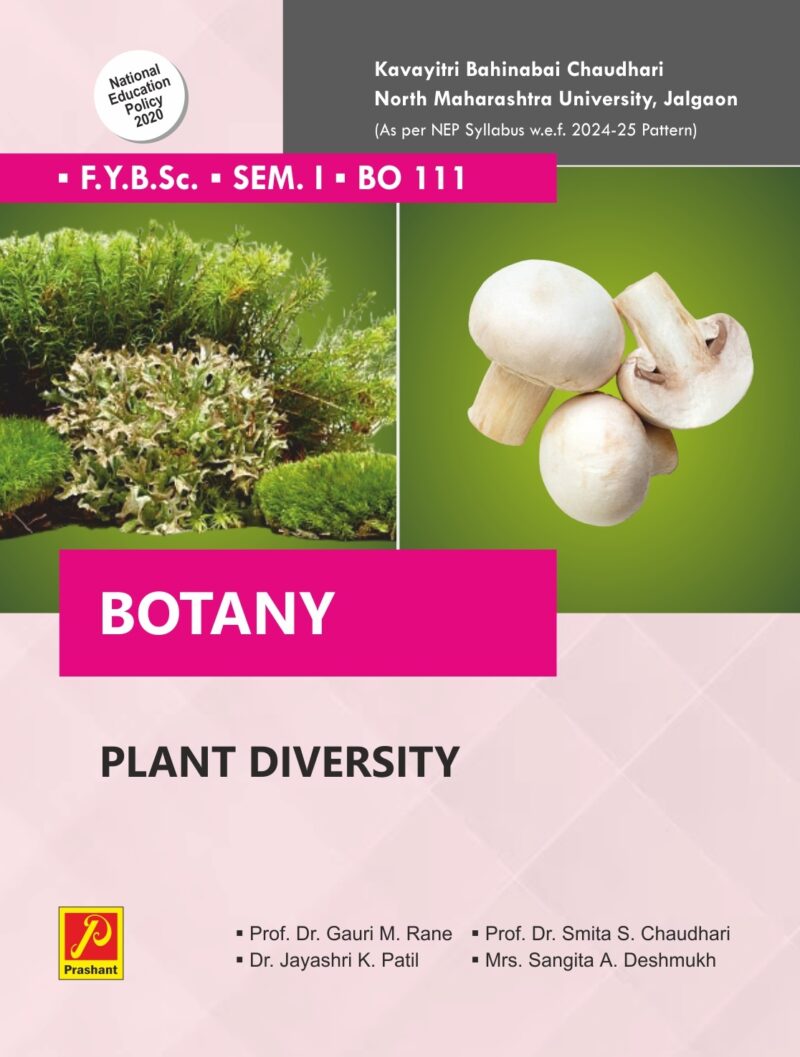

- DESCRIPTION
- INDEX
Unit 1………………………………………………………………………………………… 7
Plant Diversity and Cryptogams
1.1 Introduction.
1.2 Definition.
1.3 Important objectives of plant diversity study.
1.4 Different aspects of plant diversity w.r.t. organization, Cell structure,
Habit and habitat, Mode of nutrition, Reproduction and Diversity of Life
cycle Patterns.
1.5 General classification of Plant kingdom.
1.6 Introduction to cryptogams.
1.7 General characters of cryptogams.
1.8 Outline classification of Cryptogams.
Unit 2………………………………………………………………………………………. 23
Algae and Fungi
2.1 Introduction to Algae.
2.2 General characters w.r.t. Habit and habitat, Organization of thallus,
Structure of algal cell, Pigments, Algal flagella, Nutrition, Food reserve
and, Reproduction.
2.3 Distinguishing features of Algae.
2.4 Outline classification of Algae upto classes with two examples of each
class according to G. M. Smith (1955).
2.5 Economic importance of algae-positive and negative.
2.6 Introduction to Fungi.
2.7 General characters w.r.t. Habit and habitat, Structure of thallus, Nutrition
and, Reproduction in Fungi.
2.8 Distinguishing features of Fungi.
2.9 Outline classification of Fungi upto classes with two examples of each
class according to G.M.Smith (1955).
2.10 Economic importance of Fungi-positive and negative.
Unit 3………………………………………………………………………………………. 59
Lichens and Bacteria
3.1 Definition of Lichens.
3.2 Occurrence of Lichens.
3.3 Structure (external and Internal) of Lichens.
3.4 Types of Lichens.
3.5 Economic importance of Lichens.
3.6 Introduction to Bacteria.
3.7 General characters of Bacteria.
3.8 Classification on the basis of morphology of Bacteria.
3.9 Gram positive and negative bacteria.
3.10 Economic importance (useful and harmful) of Bacteria.
Unit 4………………………………………………………………………………………. 72
Bryophytes and Pteridophytes
4.1 Introduction to Bryophytes.
4.2 General characters w.r.t. Habit and habitat, Forms of thalli, Reproduction
and life cycle pattern of Bryophytes.
4.3 Distinguishing features of Bryophytes.
4.4 Outline classification of Bryophytes upto classes with two examples of
each class according to G. M. Smith (1955).
4.5 Economic importance of Bryophytes.
4.6 Introduction to Pteridophytes.
4.7 General characters w.r.t. Habitt and habitat, External and internal
morphology of sporophyte, Reproduction and Alternations of generations
of Pteridophytes.
4.8 Distinguishing features of Pteridophytes.
4.9 Outline classification of Pteridophytes upto classes with two examples of
each class according to G. M. Smith (1955).
4.10 Economic importance of Pteridophytes.
Unit 5…………………………………………………………………………………….. 100
Phanerogams
5.1 Introduction and General characters
Gymnosperms.
5.2 Introduction.
5.3 General characters.
5.4 Outline classification of Gymnosperms upto orders with two examples of
each order according to Chamberlain’s (1935).
5.5 Economic importance of Gymnosperm.
Angiosperms.
5.6 Introduction.
5.7 General characters.
5.8 Outline classification of Angiosperms upto Series according to Bentham
and Hooker’s.
5.9 Distinguishing features of class Monocotyledons and class Dicotyledons.
Author

Related products
-
Environmental Studies
Rs.350.00 -
Botany for Degree Student
Rs.475.00