

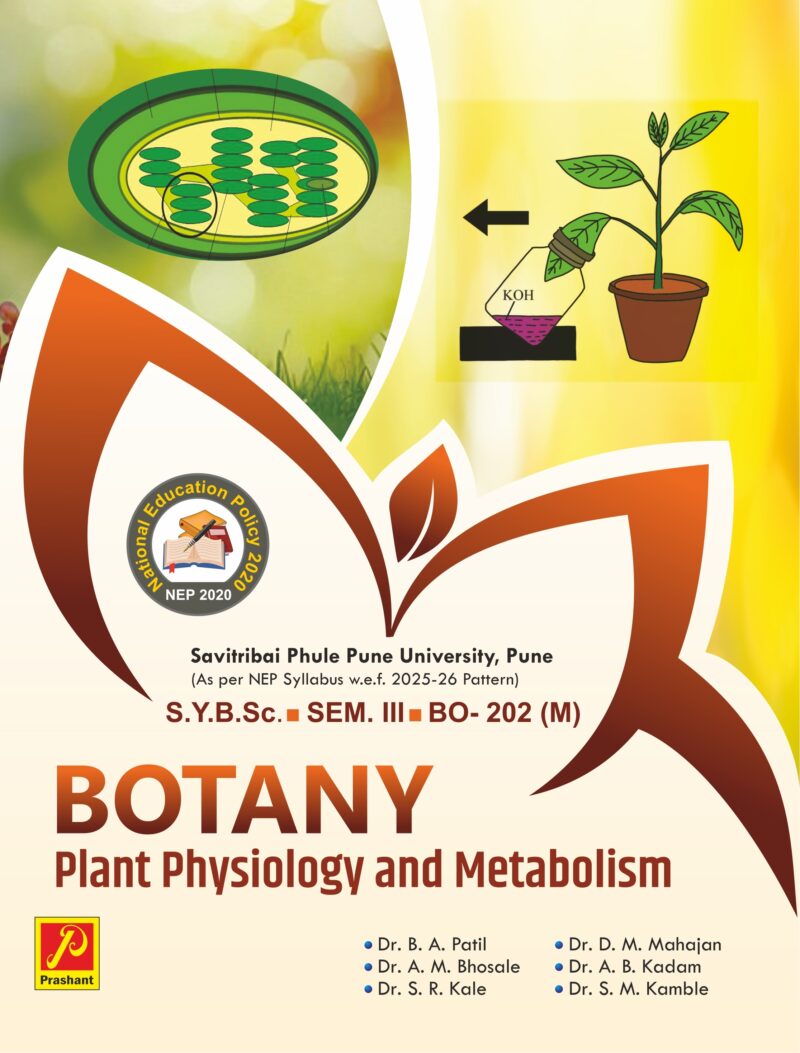
- DESCRIPTION
- INDEX
1. Introduction to Plant Physiology……………………………………………………. 7
1.1 Introduction and Definition
1.2 Scope of Plant Physiology
1.3 Importance of Plant Physiology
1.4 Exercise.
2. Plant Water Relation……………………………………………………………………. 17
2.1 Introduction
2.2 Water and its physico-chemical properties
2.3 Membrane Permeability
2.4 Diffusion
2.5 Osmosis
2.6 Relation between OP, DPD and TP
2.7 Plasmolysis
2.8 Imbibition
2.9 Difference between
2.10 Exercise
3. Water Absorption and Ascent of SAP……………………………………………. 39
3.1 Introduction
3.2 Role of water in plants
3.3 Sources of water
3.4 Concept of water holding capacity (WHC) of soil
3.5 Mechanism of water absorption
3.6 Difference between Active Water Absorption and Passive Water
Absorption
3.7 Factors affecting water absorption
3.8 Ascent of Sap
3.9 Mechanism ascent of sap
3.10 Factors affecting ascent of sap
3.11 Exercise
4. Mineral Nutrition………………………………………………………………………… 58
4.1 Introduction and Definition
4.2 Classification of essential elements
4.3 Role and deficiency symptoms of essential mineral nutrients.
4.4 Exercise5. Plant Growth Regulators (PGRs)…………………………………………………. 68
5.1 Introduction
5.2 Definition
5.3 Auxins
5.4 Cytokinins
5.5 Gibbrellins
5.6 Abscisic acid
5.7 Ethylene
5.8 Exercise
6. Transpiration………………………………………………………………………………. 81
6.1 Introduction
6.2 Definition
6.3 Types of transpiration
6..4 Structure of stomata
6.5 Mechanism of of opening and closing of stomata
6.6 Factors affecting the rate of transpiration
6.7 Antitranspirants
6.8 Guttation and exudation
6.9 Exercise
7. Nitrogen Fixation…………………………………………………………………………. 98
7.1 Introduction and Definition
7.2 Role of Nitrogen in Plants
7.3 Nitrogen Fixation by Rhizobium (Symbiotic Nitrogen Fixtation)
7.4 Nitrogenase Enzyme: Structure and Function
7.5 Nitrogen Fixtation by BGA (Non Symbiotic Nitrogen Fixation)
7.6 Exercise
8. Physiology of Flowering ……………………………………………………………. 108
8.1 Introduction
8.2 Photoperiodism
8.3 Photoperiodic induction
8.4 Phytochromes and flowering
8.5 Phytohormones and flower initiation
8.6 Application of photoperiodism
8.7 Vernalization
8.8 Mechanism of vernalization
8.9 Applications of vernalization
8.10 Devernalization
8.11 Exercise
Author

Related products
Practical Botany
Rs.85.00Horticulture and Practicals-1
Rs.265.00BO-233 & 243 | Practical Botany
Rs.175.00