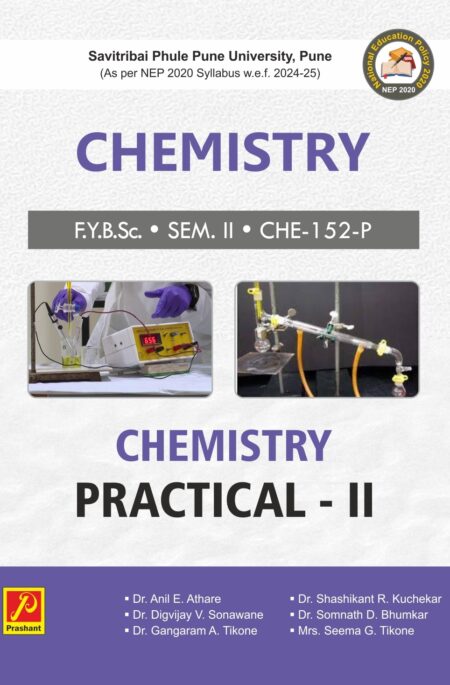


- DESCRIPTION
- INDEX
Section – I
PHYSICAL AND ANALYTICAL CHEMISTRY – I
Experiment No. 1……………………………………………………………………………………………………….. 7
Determination of unknown concentration of KMnO4 by Colorimetry.
Experiment No. 2……………………………………………………………………………………………………… 12
Estimation of Cu ++ ion by using EDTA Colorimetrically.
Experiment No. 3……………………………………………………………………………………………………… 15
Study the kinetics of acid hydrolysis of methyl acetate with hydrochloric acid.
Experiment No. 4……………………………………………………………………………………………………… 18
Compare the strengths of HCl and H2SO4 by studying kinetics of hydrolysis of methyl acetate.
Experiment No. 5……………………………………………………………………………………………………… 21
Determination of Heat of Neutralization of Strong Acid & Strong Base.
Experiment No. 6……………………………………………………………………………………………………… 24
Study of kinetics of decomposition of H2O2 (Clock Reaction).
Section – II
ORGANIC CHEMISTRY
Experiment No. 1……………………………………………………………………………………………………… 27
To purify the given organic compounds by Crystallization.
Experiment No. 2……………………………………………………………………………………………………… 29
To purify the given organic compounds by Sublimation.
Experiment No. 3……………………………………………………………………………………………………… 30
To purify the given organic compounds by Simple Distillation.
Experiment No. 4……………………………………………………………………………………………………… 32
To purify the given organic compounds by Steam Distillation.
Experiment No. 5……………………………………………………………………………………………………… 34
Detection of elements (N, S, Cl, Br, I) in organic compounds
Section – III
INORGANIC CHEMISTRY
a. Investigative Experiments in Inorganic Chemistry (Any two)
Experiment No. 1……………………………………………………………………………………………………… 37
To study Stoichiometry of Reaction between KMnO4 and FeSO4 by titration method.
Hence Determination of Number of electrons involved in the reaction and Equivalent
Weight of the Oxidizing Agent-KMnO4.
Experiment No. 2……………………………………………………………………………………………………… 40
Determination of dissociable H+ ion (Basicity) of Boric Acid. Hence Determination of
its Equivalent Weight by Acid-Base Titration.
Experiment No. 3……………………………………………………………………………………………………… 43
To estimate water of crystallization in Mohr’s salt by titrating with KMnO4.
b. Table work (Compulsory)
Experiment No. 1……………………………………………………………………………………………………… 48
To sketch the polar plots of ‘s’ and ‘p’ orbital.
c. Chemistry with Computers (Any one)
Experiment No. 1……………………………………………………………………………………………………… 55
Study of molecular properties of some molecules using open access computational
chemistry package AVOGADRO.
Experiment No. 2……………………………………………………………………………………………………… 56
Draw the structure of HX (X= halide). Record bond length, dipole moment and partial
charges and explain observed trend in periodicity in halide group.
Experiment No. 3……………………………………………………………………………………………………… 59
Draw the structure H2O, H2S, H2Se and H2Te molecule in Avogadro, optimize structure, record
molecular properties and explain observed bond angles (on the basis of VSEPR theory).
Experiment No. 4……………………………………………………………………………………………………… 61
Draw the structure of CH4, NH3 and H2O molecule in Avogadro, optimize structure, record
molecular properties and explain observed bond angles (on the basis of VSEPR theory).
Stock Solutions………………………………………………………………………………………………….. 64
Author

Related products
-
Word Processing with Google Docs
Rs.110.00 -
C Programming – I
Rs.85.00 -
Google Apps (Hands on)
Rs.95.00 -
Cooperative Law & Micro Finance – II
Rs.150.00