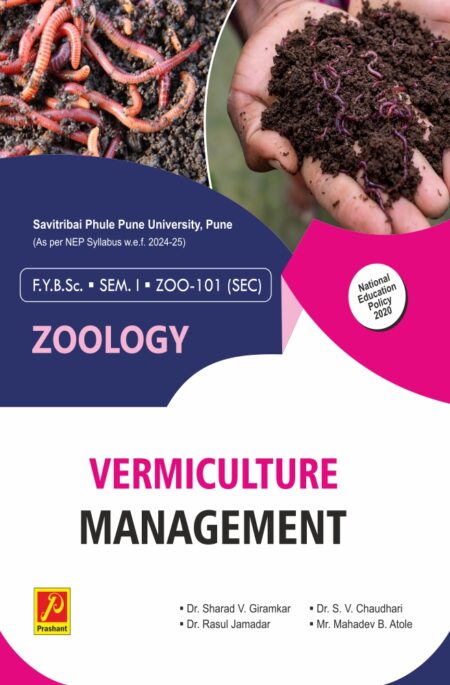

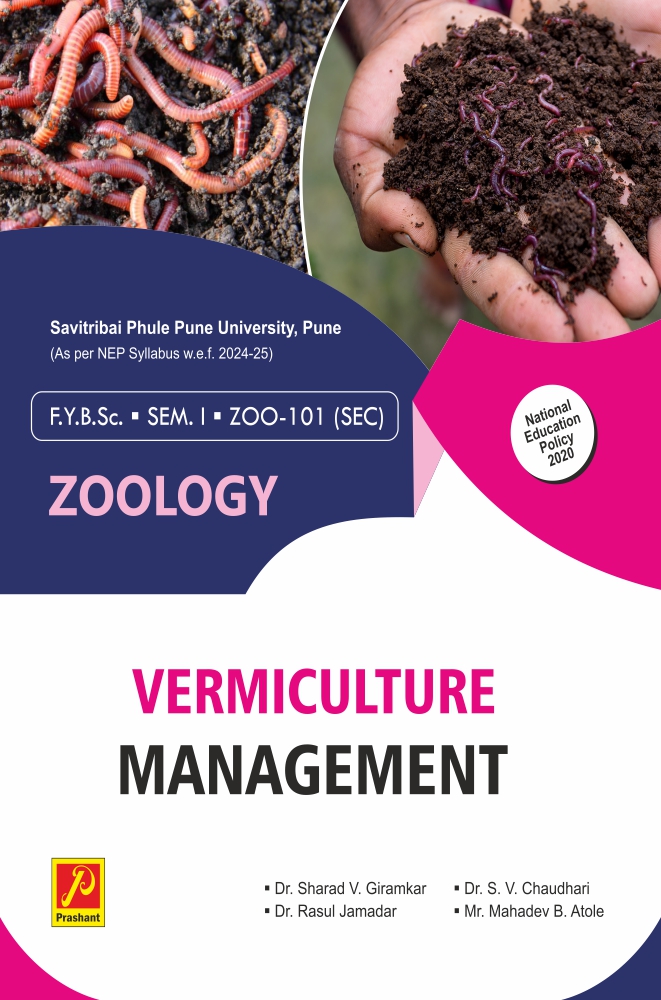

- DESCRIPTION
- INDEX
1. Chapter
Introduction To Vermiculture
1.1 Definition, history and its importance in maintenance of soil structure.
1.2 Role of vermiculture in four R’s of recycling (Reduce, Reuse, Recycle and Restore).
1.3 The matter and humus cycle (product, qualities) of earthworm.
1.4 Transformation process in organic matter.
2. Chapter
Types of Earthworms
2.1 Types of earthworms – Epigeic, Endogeic and Anecic.
2.2 Indigenous species of earthworms.
2.3 Exotic species of earthworms.
2.4 Useful species of earthworm: Eisenia fetida, Eudrilus eugeniae, Lumbricus rubellus, Perionyx excavatus etc.
3. Chapter
Biology of Earthworm (Eisenia foetida or Eudrilus eugeniae)
3.1 Enemies of honey bee : Wax moth, Wax beetle, Wasps, Ants, Birds (Green bee eater, King crow), Amphibians and Mammals.
3.2 Bee diseases : Protozoan (Nosema), Bacterial (American foul brood), Viral (Sac brood), Fungal (Chalk brood).
3.3 Control and preventive measures of Bee diseases.
4. Chapter
Vermicomposting
4.1 Small scale earthworm farming for house gardens.
4.2 Conventional commercial composting / Large scale earthworm farming -Pit system, Heap system, Brick system, Kadapa slab method.
4.3 Earthworm – Feeding and Maintenance.
4.4 Vermicompost harvest, processing, and packaging.
4.5 Vermi-wash preparation, composition, collection & uses.
5. Chapter
Enemies and Diseases of Earthworms
5.1 Enemies of Earthworm – Ants, Birds, Rats, Snakes, Toads.
5.2 Diseases of Earthworm – Bacterial, Protozoan, Fungal.
6. Chapter
Economic Importance and Marketing
6.1 Economic importance of earthworms, vermicompost and vermiwash.
6.2 Vermicompost as business / marketing of Vermicompost, Employment opportunities.
Author

Related products
ZO 364 | Entomology
Rs.130.00ZO-352 | Histology
Rs.110.00ZO-353 | Biological Chemistry
Rs.240.00ZOO-122 | Cell Biology
Rs.135.00