
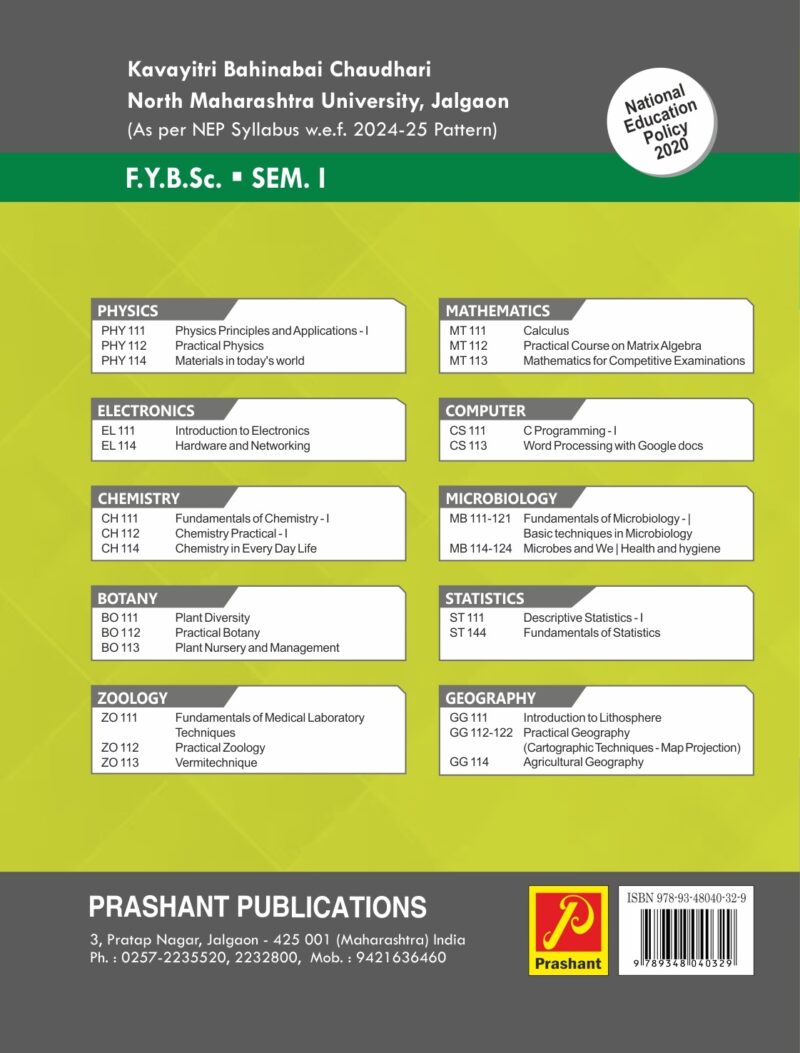
- DESCRIPTION
- INDEX
Unit 1…………………………………………………………………………………………7
Current Electricity
1.1 Electric Charge
1.2 Basic Properties of Electric Charge
1.3 Electric Current
1.4 Unit of Electrical Current
1.5 Average and Instantaneous Current
1.6 Direction of flow of charges and conventional current flow
1.7 Drift Velocity
1.8 Wire gauge
1.9 Current Density
1.10 Operation of an incandescent lamp
1.11 Resistivity
1.12 Temperature dependence of resistivity
1.13 Resistance
1.14 Difference between Resistance and Resistivity
1.15 Factors Affecting Electrical Resistance
1.16 Electric Power
1.17 Power Dissipation in Resistor
1.18 Electrical Energy
1.19 Electrical power and Electric Energy Difference
1.20 Energy efficiency and cost effectiveness of appliancess. Unit 2……………………………………………………………………………………….33
Electric Circuit Analysis
2.1 Introduction
2.2 Concept of DC and AC
2.3 Introduction to Circuit Elements
2.4 Concept of Nodes, Branches and Loops
2.5 Kirchhoff’s Laws and Loop analysis by Kirchhoff’s Laws
2.6 Series resistors for voltage division and parallel resistors for current division
2.7 Thevenin’s theorem
2.8 Norton’s Theorem
2.9 Difference between Thevenin’s and Norton’s Theorem
2.10 Maximum Power Transfer Theorem. Unit 3……………………………………………………………………………………..100 Electromagnetism
3.1 Introduction
3.2 Faraday’s Law
3.3 Lenz’s law
3.4 Motional emf
3.5 Working of electric generator
3.6 Mutual Inductance
3.7 Self-Inductance and Inductors: Example of metal detector system.
Unit 4……………………………………………………………………………………..129 Optics
4.1 Introduction
4.2 Image formation by Reflection
4.3 The Mirror Equation
4.4 Refraction of light
4.5 Applications of Refraction of Light
4.6 Apparent Depth
4.7 Refraction at a Spherical Interface (convex surface)
4.8 Ray Tracing and Thin Lenses
4.9 Image Formation by Thin Lenses
4.10 Lens Maker’s Equation
4.11 Camera
4.12 What are the Zoom lenses
4.13 Projector
4.14 Human eye
4.15 Defects and corrections of vision in Human eye
4.16.1 Magnifier or Simple Microscope
4.16.2 Compound Microscope:
4.17 Telescope
Author

Related products
Practical Physics
Rs.70.00PHY-101 | Basic Mechanics
Rs.125.00PHY-103-203 | Practical Physics
Rs.130.00